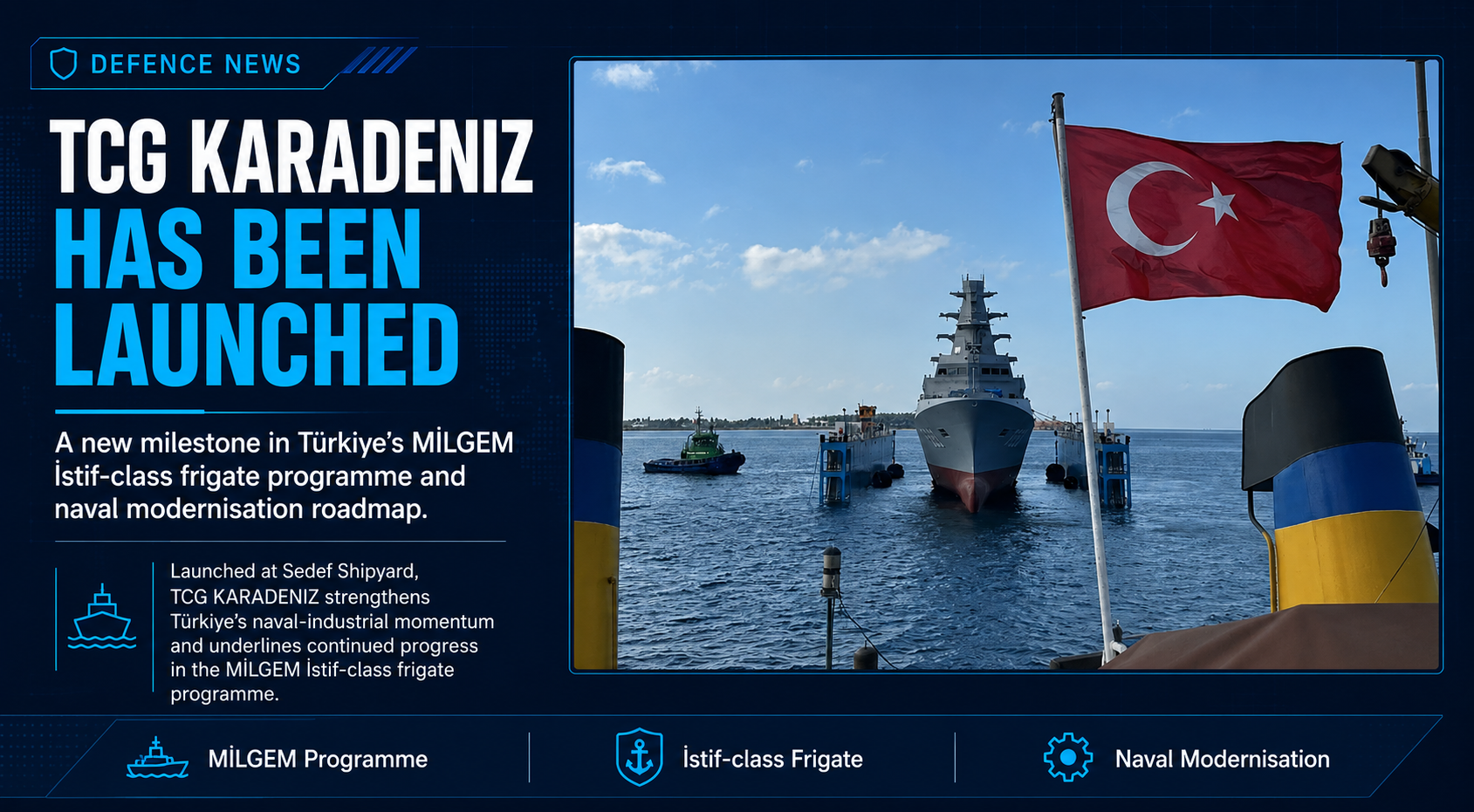
TCG KARADENIZ has been launched, marking another milestone in Türkiye’s MİLGEM İstif-class frigate programme and the country’s wider naval modernisation effort.
According to DefenceTurk, TCG KARADENİZ (F-520) is the sixth ship of the İstif-class frigate line and was built at Sedef Shipyard under STM main contractorship. The launch moves the ship from hull construction into the next phase of outfitting, integration and testing before eventual delivery to the Turkish Navy.
The development is important because the İstif-class is not only a shipbuilding programme. It is also a national combat-systems programme that brings together Turkish sensors, weapons, launch systems, shipyard capacity and naval design know-how.
TCG KARADENIZ Adds Momentum to the İstif-Class Programme
TCG KARADENIZ is part of Türkiye’s effort to expand and modernise its surface-combatant fleet through locally built frigates. The İstif class follows the Ada-class corvette experience and gives the Turkish Navy a larger, more heavily armed national frigate design.
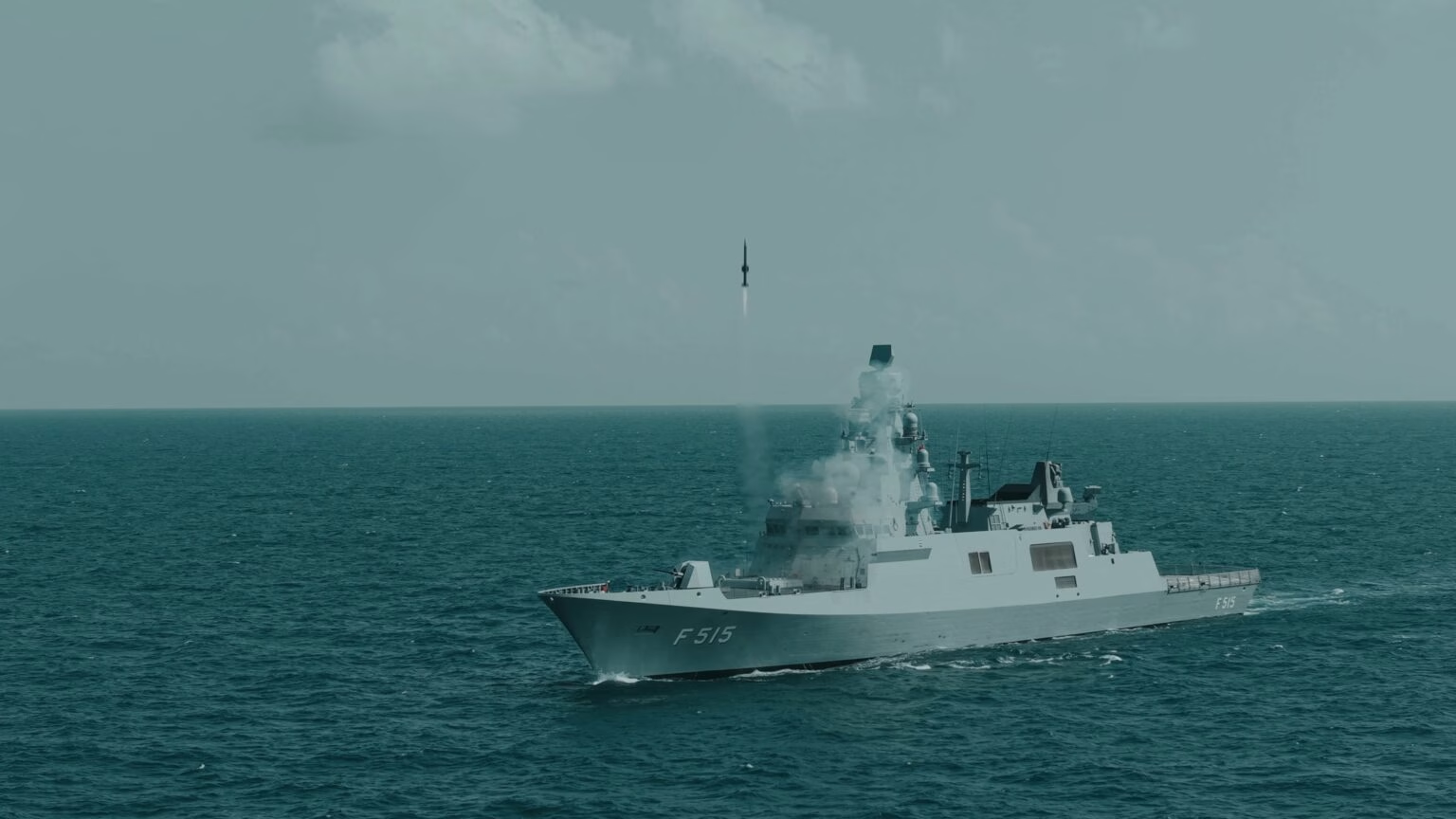
DefenceTurk reported that TCG İSTANBUL (F-515), the lead ship of the class, is already active. TCG İZMİR (F-516) is continuing sea trials, while TCG İZMİT (F-517), TCG İÇEL (F-518), TCG AKDENİZ (F-519) and now TCG KARADENİZ (F-520) have been launched. TCG EGE (F-521) and TCG MARMARA (F-522) remain under construction.
This sequence shows that the programme has moved beyond a single national-frigate prototype. It is now a serial shipbuilding effort involving multiple yards, subcontractors and national mission-system suppliers.
Why the Launch Matters
A launch is not the same as commissioning. TCG KARADENIZ will still require outfitting, harbour tests, combat-system integration, sea trials and acceptance activities before entering operational service.
However, the launch is a visible production milestone. It means the hull has reached a stage where the ship can be moved into the water and prepared for the next phases of completion.
For Türkiye, this is especially significant because the İstif-class programme is tied to industrial continuity. Each ship helps sustain national shipbuilding expertise, combat-system integration capability and the supply chain behind naval platforms.
A National Combat-Systems Architecture
The İstif-class frigates are designed around a high share of national systems. SSB previously stated that the ships would be equipped with national sensors and weapons, including GÖKDENİZ close-in air defence, CENK-S three-dimensional search radar, AKREP fire-control radar, MİDLAS national vertical launch system and HİSAR-D air-defence missile capability.
This architecture is strategically important. Surface combatants are no longer judged only by hull size or speed. Their value depends on sensors, missiles, electronic systems, command-and-control architecture, vertical launch capacity and integration with wider fleet networks.
By integrating national systems into the İstif class, Türkiye reduces dependence on foreign suppliers and gains more freedom to upgrade, adapt and export naval designs over time.
Localisation Is a Core Programme Objective
DefenceTurk reported that the lead ship TCG İSTANBUL exceeded the original localisation target and reached an 80% domestic-content level. The report also states that more than 80 subcontractors contributed to over 150 systems, while around 220 companies participated across the wider project.
This industrial footprint matters because frigates are complex systems of systems. A warship brings together propulsion, power distribution, radars, weapons, communications, electronic warfare, hull structures, software, combat-management systems and sustainment infrastructure.
The İstif-class therefore gives Türkiye more than new ships. It supports a larger maritime defence-industrial base capable of designing, building, integrating and sustaining high-end naval platforms.
Multiple Shipyards Create Parallel Production Capacity
The İstif-class programme also demonstrates Türkiye’s ability to distribute complex naval construction across private shipyards. SSB’s earlier announcement stated that Anadolu, Sedef and Sefine shipyards would each build one İ-class frigate in parallel under the STM-TAIS framework.
Parallel production is strategically valuable. It shortens delivery timelines, spreads industrial workload and reduces dependence on a single yard. It also increases national resilience by allowing multiple shipyards to gain experience with naval combatant construction.
TCG KARADENIZ, built at Sedef Shipyard, is part of this wider production model. Its launch shows that the private-yard structure continues to generate visible progress for the Turkish Navy.
The İstif Class Fills a Fleet Modernisation Requirement
The Turkish Navy requires modern surface combatants able to operate across the Eastern Mediterranean, Black Sea, Aegean and wider maritime approaches. The İstif-class frigates are designed to support this requirement with anti-submarine warfare, surface warfare, air defence, reconnaissance, surveillance and early-warning roles.
SSB describes the İ-class frigates as larger than the Ada-class corvettes and differentiated by their air-defence missile capability. This makes them more suitable for escort, area awareness, fleet air-defence contribution and high-tempo naval operations.
For Türkiye, that capability is essential because naval competition is increasingly shaped by missiles, drones, submarines, electronic warfare and long-range sensors.
MİDLAS and HİSAR-D Are Key Sovereignty Markers
One of the most important elements of the İstif-class frigates is MİDLAS, Türkiye’s national vertical launch system. A domestic vertical launcher gives the Navy more flexibility in integrating national missile families and reduces reliance on foreign launch-system permissions.
The expected integration of HİSAR-D and other national air-defence solutions also increases the programme’s strategic value. Air and missile defence at sea is one of the hardest and most expensive capability areas for modern navies.
If Türkiye can scale national shipborne air-defence systems across the İstif class and future platforms, it will strengthen both naval deterrence and export credibility.
TCG KARADENIZ and the Black Sea Dimension
The name TCG KARADENIZ also carries strategic resonance. The Black Sea has become a central theatre for naval security, mine warfare, maritime surveillance, drone operations, missile threats and critical infrastructure protection.
Although the ship is not limited to one region, its entry into the İstif-class production sequence reinforces Türkiye’s broader need for flexible surface combatants able to operate across multiple maritime theatres.
Modern frigates must be able to work with unmanned systems, submarines, maritime patrol aircraft, coastal sensors and joint command networks. The İstif class provides a platform for that evolving networked naval structure.
What Happens After Launch
After launch, TCG KARADENIZ will enter a demanding phase. The ship will need further outfitting, installation and calibration of mission systems, harbour acceptance tests, propulsion checks, communications validation and combat-system integration.
Sea trials will then test performance, manoeuvrability, endurance, sensors, navigation systems and operational safety. Weapons and combat systems will require additional validation before the ship can be accepted for service.
This means the launch is a major milestone, but the most important technical work continues after the ship enters the water.
A Signal for Naval Exports
The İstif-class programme also has export relevance. Türkiye’s ability to build national frigates with domestic combat systems strengthens its position in the global naval market.
Many countries are seeking medium-displacement surface combatants with modern sensors, missile systems, national-customisation options and lower lifecycle costs than some Western European alternatives.
For potential customers, serial production is important. A design becomes more credible when it is built in multiple hulls, tested by the national navy and supported by a broad industrial base.
Why This Matters for Türkiye’s Defence Industry
TCG KARADENIZ shows the maturity of Türkiye’s naval defence industry. The programme brings together STM, private shipyards, electronics companies, weapons producers, radar suppliers, software teams and many smaller subcontractors.
This is exactly the type of complex programme that builds long-term industrial depth. Naval combatants require coordination across engineering, production, integration, certification, logistics and lifecycle support.
As more İstif-class ships move through construction, launch, sea trials and commissioning, Türkiye gains experience that can support future projects such as air-defence destroyers, larger frigates, unmanned naval systems and export variants.
Conclusion
TCG KARADENIZ is more than another hull entering the water. It is a signal that Türkiye’s İstif-class frigate programme is moving through serial production and strengthening the Navy’s future surface-combatant force.
The ship’s launch at Sedef Shipyard reflects the role of private shipyards in national naval construction. Its national systems architecture reflects Türkiye’s push for sovereign combat capability. Its place in the MİLGEM sequence reflects the country’s broader maritime-industrial ambition.
The next test will be execution after launch. If TCG KARADENIZ completes outfitting, integration and trials on schedule, it will further reinforce the İstif-class programme as one of Türkiye’s most important naval modernisation efforts.
For further Defence Agenda coverage, read our naval warfare, defence industry and Türkiye sections. Related analysis includes unmanned underwater vehicles and naval warfare, A2/AD doctrine and layered defence and defence export event strategy.