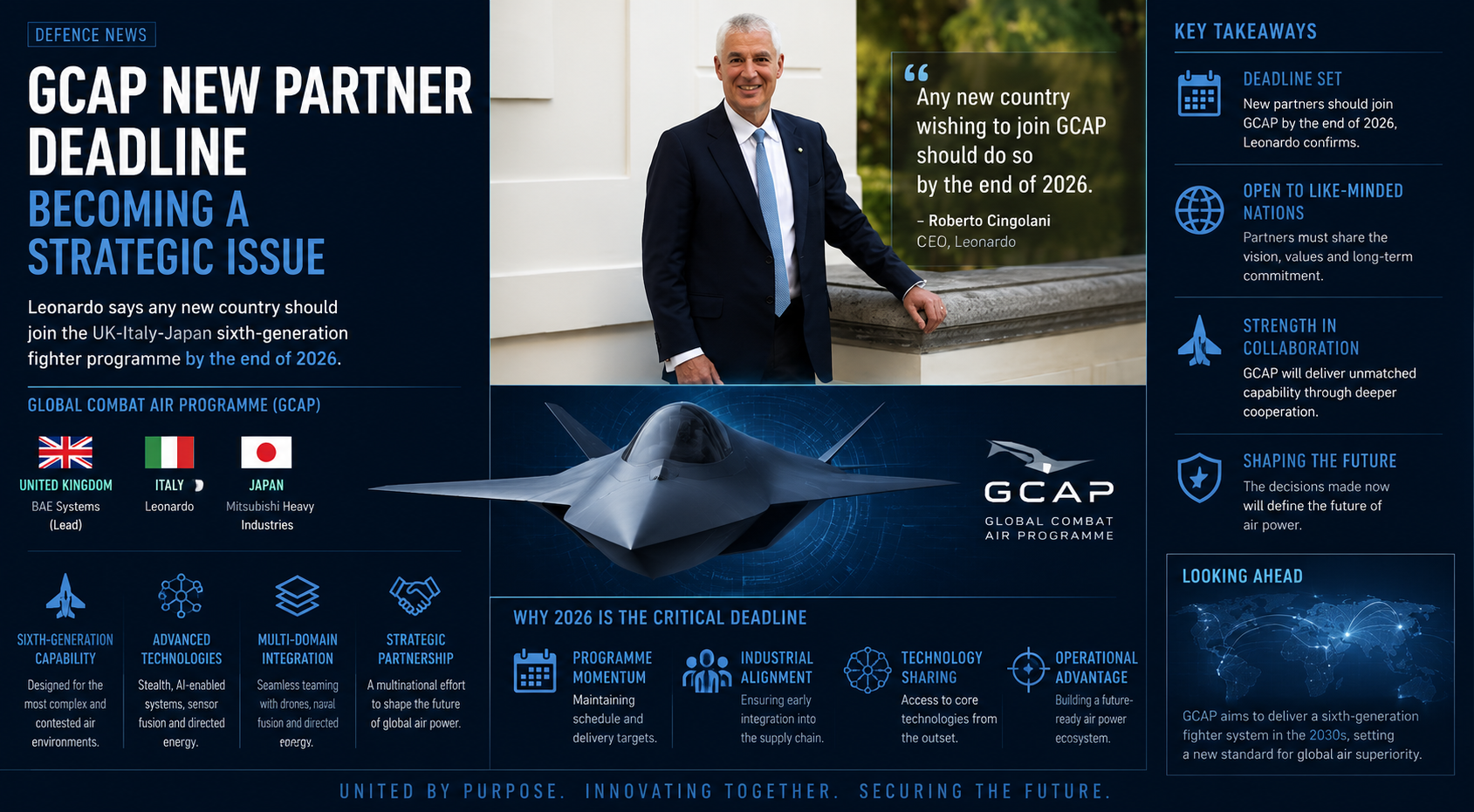
GCAP new partner deadline is becoming a strategic issue as Leonardo signals that any additional country seeking to join the UK-Italy-Japan sixth-generation fighter programme should move before the end of 2026.
Reuters reported that Leonardo CEO Lorenzo Mariani said the Global Combat Air Programme, or GCAP, cannot keep its expansion window open indefinitely. From an industry perspective, he argued that any new partner should join by the end of 2026, with roughly 12 months as the final deadline.
The timing matters because GCAP is targeting a next-generation combat aircraft by 2035. Adding a new partner could bring industrial scale, funding and technology depth. However, it could also complicate governance, workshare, requirements and schedule control.
GCAP New Partner Deadline Reflects Schedule Pressure
The most important message from Leonardo is schedule discipline. GCAP is not an early-stage political concept anymore. It is moving deeper into engineering, industrial organisation and aircraft definition.
That makes partner expansion more difficult with time. A country that joins early can shape requirements, industrial participation, technology planning and programme governance. A country that joins later may face a narrower role and fewer opportunities to influence the aircraft’s baseline design.
This is why the 2026 window is strategically significant. GCAP can still grow, but the programme cannot allow expansion to threaten its 2035 target.
Canada Has Opened the Expansion Model
Canada’s entry as the first Observer Nation has created the first formal expansion pathway for GCAP beyond the founding partners. The UK, Italy and Japan welcomed Canada on 21 July 2026, giving Ottawa structured access to programme insight without full partner status.
The observer model is important because it creates a staged route into the programme. Canada can study capability development, industrial collaboration, governance, security requirements and long-term delivery planning before deciding whether deeper participation makes sense.
For GCAP, this approach reduces immediate risk. It allows the programme to build relationships with trusted partners without instantly changing core governance or financial commitments.
Germany Is the Most Politically Sensitive Candidate
Germany is now one of the most discussed potential GCAP partners. Reuters reported that Mariani described Germany as a suitable partner because of its expertise, expanding defence budget and existing Eurofighter Typhoon cooperation with the UK and Italy.
The German question is politically sensitive because Europe’s fighter-aircraft landscape is already fragmented. GCAP competes for talent, funding, suppliers and strategic attention with other European combat-air initiatives.
If Germany joined GCAP, the programme could gain industrial depth and political weight. However, it would also need to manage workshare expectations, technology access, export policy and programme authority.
Saudi Arabia Remains a Possible Partner
Saudi Arabia has also been widely discussed as a potential GCAP participant. Mariani said there is still interest from Saudi Arabia in being part of the programme.
The Saudi question is different from the German one. It is less about European industrial consolidation and more about funding, export strategy, long-term airpower modernisation and strategic defence relationships.
However, bringing in a Middle Eastern partner would require careful management of technology protection, export-control policy, operational requirements and political alignment among the founding governments.
The 2035 Target Is the Core Constraint
The defining constraint for GCAP is the 2035 aircraft target. Japan is especially focused on this date because it must manage the future retirement of its F-2 fighter fleet and maintain airpower credibility in a challenging regional environment.
Leonardo’s message suggests that the programme may not only protect the 2035 target but may face pressure to accelerate it. That increases the importance of disciplined requirements, digital engineering, industrial readiness and decision speed.
Any new partner must therefore add value without slowing the programme. That is the central test for GCAP expansion.
Edgewing Is Now the Industrial Core
The industrial centre of gravity is Edgewing, the joint venture created by BAE Systems, Leonardo and Japan Aircraft Industrial Enhancement. Edgewing is the trinational prime contractor and design authority for the GCAP aircraft.
The GCAP Agency awarded Edgewing a £4.6 billion contract in July 2026 to support the advanced concept and assessment phase, detailed design and development work. The contract follows an earlier £686 million contract placed in April 2026.
This matters because the programme is now moving through institutional and industrial milestones. Expansion decisions must fit into a structure that already has a customer, prime contractor, design authority and funded engineering path.
GCAP Is More Than a Fighter Jet
GCAP should not be understood only as a fighter-aircraft programme. The UK government describes the aircraft as a sixth-generation system that will operate alongside F-35s and use advanced autonomy, artificial intelligence, uncrewed systems and next-generation sensors.
This makes GCAP a future combat-air system rather than a single platform. The aircraft will need to connect with drones, sensors, datalinks, weapons, electronic warfare systems, cyber-resilient networks and multi-domain command architectures.
That wider system architecture is exactly why partner selection matters. A new country would not only join an aircraft programme. It would join a long-term industrial and technological ecosystem.
New Partners Could Strengthen Industrial Scale
Adding another country could strengthen GCAP in several ways. It could expand funding, increase production volume, add technical expertise, deepen supply chains and widen the future export base.
This is especially important because sixth-generation combat aircraft will be extremely expensive to develop. Sharing cost and risk across more trusted partners could make the programme more resilient.
However, scale only helps if it is controlled. Too many national requirements can create complexity, delays and cost growth. The programme must avoid becoming a negotiation forum rather than an engineering organisation.
The Workshare Problem Will Be Difficult
The hardest issue for any new GCAP partner will be workshare. Defence-industrial partnerships are not only about military capability. They are also about jobs, intellectual property, production sites, export control, supplier participation and technology access.
Germany, Saudi Arabia or any other candidate would likely seek meaningful industrial participation. Yet the founding partners already have established roles through BAE Systems, Leonardo, Mitsubishi Heavy Industries and Japan Aircraft Industrial Enhancement.
This creates a negotiation challenge. GCAP must be open enough to attract partners but firm enough to preserve schedule, design authority and industrial coherence.
Observer Status Could Become the Preferred Path
Canada’s observer status may become the model for future countries. It allows potential partners to gain structured insight before full commitment, while protecting the programme from immediate governance disruption.
This pathway is useful because countries may not be ready to commit financially or politically at once. Observer status gives them time to understand requirements, industrial opportunities and strategic fit.
For GCAP, the observer model also creates leverage. It can welcome partners without giving away full decision rights too early.
The Main Risk Is Delay
The main risk of adding new partners is delay. Sixth-generation fighter programmes already face demanding technical challenges in stealth, propulsion, sensors, autonomy, data systems, weapons integration, software assurance and survivability.
A new country could introduce additional requirements, industrial negotiations, security reviews and export-policy questions. Even small changes can have major consequences when aircraft architecture is being defined.
This is why Leonardo’s deadline matters. It draws a line between expansion as an opportunity and expansion as a threat to delivery.
The Strategic Competition Is Wider Than Europe
GCAP is being shaped by global strategic competition. Japan faces a demanding Indo-Pacific security environment. The UK and Italy want to preserve high-end combat-air sovereignty. Canada is exploring deeper defence-industrial cooperation beyond traditional procurement patterns.
At the same time, future combat-air markets are becoming more crowded. The United States is pursuing next-generation airpower, European states are reassessing fighter cooperation, and emerging air forces are evaluating long-term sovereign options.
GCAP’s expansion question is therefore not only internal programme management. It is about which countries will shape the next generation of air superiority.
What This Means for Defence Industry
For industry, the next year could be decisive. A new partner could change supplier opportunities, electronics workshare, propulsion planning, mission-system integration and export prospects.
Companies across sensors, propulsion, materials, avionics, weapons, digital engineering, AI, simulation and secure communications will watch the expansion decision closely.
The countries that enter early will have a better chance to shape the industrial architecture. Those that wait may still buy the aircraft later, but with less influence over design and technology pathways.
A Practical Expansion Test for GCAP
GCAP should test any potential partner against five questions. First, does the country add funding without slowing governance? Second, does it bring technology or industrial capacity that fills a real gap? Third, can its requirements fit the baseline aircraft design?
Fourth, can export-control and technology-protection issues be managed among all partners? Fifth, does the country strengthen the 2035 delivery path rather than weaken it?
If the answer is positive, expansion could make GCAP stronger. If not, the founding partners may choose to protect speed over size.
Conclusion
The GCAP new partner deadline shows that the UK-Italy-Japan fighter programme is entering a more disciplined phase. The programme can still expand, but not at the expense of the 2035 target.
Canada’s observer status has created a flexible expansion model. Germany and Saudi Arabia remain politically and strategically significant possibilities. However, any new partner must bring value without disrupting design authority, industrial workshare or schedule control.
The next year may therefore define the future shape of GCAP. It will decide whether the programme remains a tightly controlled trilateral project with observers, or becomes a broader multinational combat-air ecosystem for the sixth-generation era.
For further Defence Agenda coverage, read our air warfare, aerospace and defence industry sections. Related analysis includes Storm Fighter and the UK’s sixth-generation airpower shift, wingman aircraft and European rearmament and future warfare technologies and military strategy.
Further Reading
- Reuters: Leonardo CEO says deadline for new country to join GCAP should be next year
- GOV.UK: Canada joins GCAP as first Observer Nation
- Canada.ca: Quadrilateral joint statement on Canada becoming an Observer to GCAP
- GOV.UK: £4.6bn contract for GCAP next-generation fighter jet
- Edgewing: Next stage of trinational fighter jet programme takes off with £4.6bn contract